Microfluidic out-of-equilibrium control of molecular nanotubes

22-4-2020
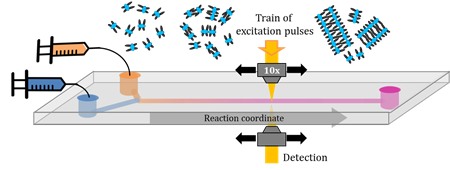
We employed a lab-on-a-chip approach as a means to obtain in situ control of the structural complexity of an artificial light-harvesting complex: molecular double-walled nanotubes.
Rapid and stable dissolution of the outer wall was realized via microfluidic mixing thereby rendering the thermodynamically unstable inner tubes accessible to spectroscopy. By measurement of the linear dichroism and time-resolved photoluminescence of both double-walled nanotubes and isolated inner tubes we show that the optical (excitonic) properties of the inner tube are remarkably robust to such drastic perturbation of the system’s supramolecular structure as removal of the outer wall.
This work was published in the journal Physical Chemistry Chemical Physics
It can be downloaded here.
Hot electrons harvested without tricks

18-11-2019
Semiconductors convert energy from photons (light) into an electron current. However, some photons carry too much energy for the material to absorb. These photons produce "hot electrons," and the excess energy of these electrons is converted into heat. Materials scientists have been looking for ways to harvest this excess energy. Scientists from the University of Groningen and Nanyang Technological University (Singapore) have now shown that this may be easier than expected by combining a perovskite with an acceptor material for hot electrons. Their proof of principle was published in Science Advances on 15 November.
Press release from University Groningen, the Netherlands
Press release from Nanyang Technology University, Singapore
Teacher of the year
13-2-2019
Prof. Maxim Pchenitchnikov was elected "Teacher of the Year 2018" for the bachelor and master program Physics and Applied Physics
Back cover of Journal of Materials Chemistry C
21 Januari 2019
Long-range exciton transport in brightly fluorescent furan/phenylene co-oligomer crystals
Artur A. Mannanov, Maxim S. Kazantsev, Anatoly D. Kuimov, Vladislav G. Konstantinov, Dmitry I. Dominskiy, Vasiliy A. Trukhanov, Daniil S. Anisimov, Nikita V. Gultikov, Vladimir V. Bruevich, Igor P. Koskin, Alina A. Sonina, Tatyana V. Rybalova, Inna K. Shundrina, Evgeny A. Mostovich, Dmitry Yu. Paraschuk and Maxim S. Pshenichnikov
Journal of Materials Chemistry C, 7, p. 70-80 (2019)
Showcasing collaborative research from Rijksuniversiteit Groningen in The Netherlands, Lomonosov Moscow StateUniversity, Novosibirsk State University and VorozhtsovNovosibirsk Institute of Organic Chemistry, Russia.
The article featured the back cover of J. Materials Chemistry C.
Front cover
May 23, 2018
Our research features the front cover of Advanced Functional Materials
In article number 1800116, Sergei A. Ponomarenko, Maxim S. Pshenichnikov, Dmitry Yu. Paraschuk, and co-workers propose an innovative concept of molecular self‐doping. The art shows how a highly luminescent dopant emerges as a minute‐amount by-product during the host material synthesis to enhance luminescence of organic crystals. The self-doping concept opens an easy route to highly luminescent semiconductor organic crystals for optoelectronics applications
Molecular Self-Doping Controls Luminescence of Pure Organic Single Crystals
March 14, 2018
Modern light-emitting devices such as top-level TV screens are based on organic luminescent semiconductor materials. The two key requirements for them are efficient luminescence and high charge carrier mobility. The latter requires tight molecular packing readily achieved in organic semiconductor single crystals, but it also results in inhibiting the light emission because of luminescence quenching. This dichotomy is resolved by doping of the host crystals with highly luminescent organic molecules which requires their chemical synthesis and subsequent smooth embedding into the host.
Page 7 of 8